Choose a role
A role maps to supported technical domains. A job description can add relevance hints.
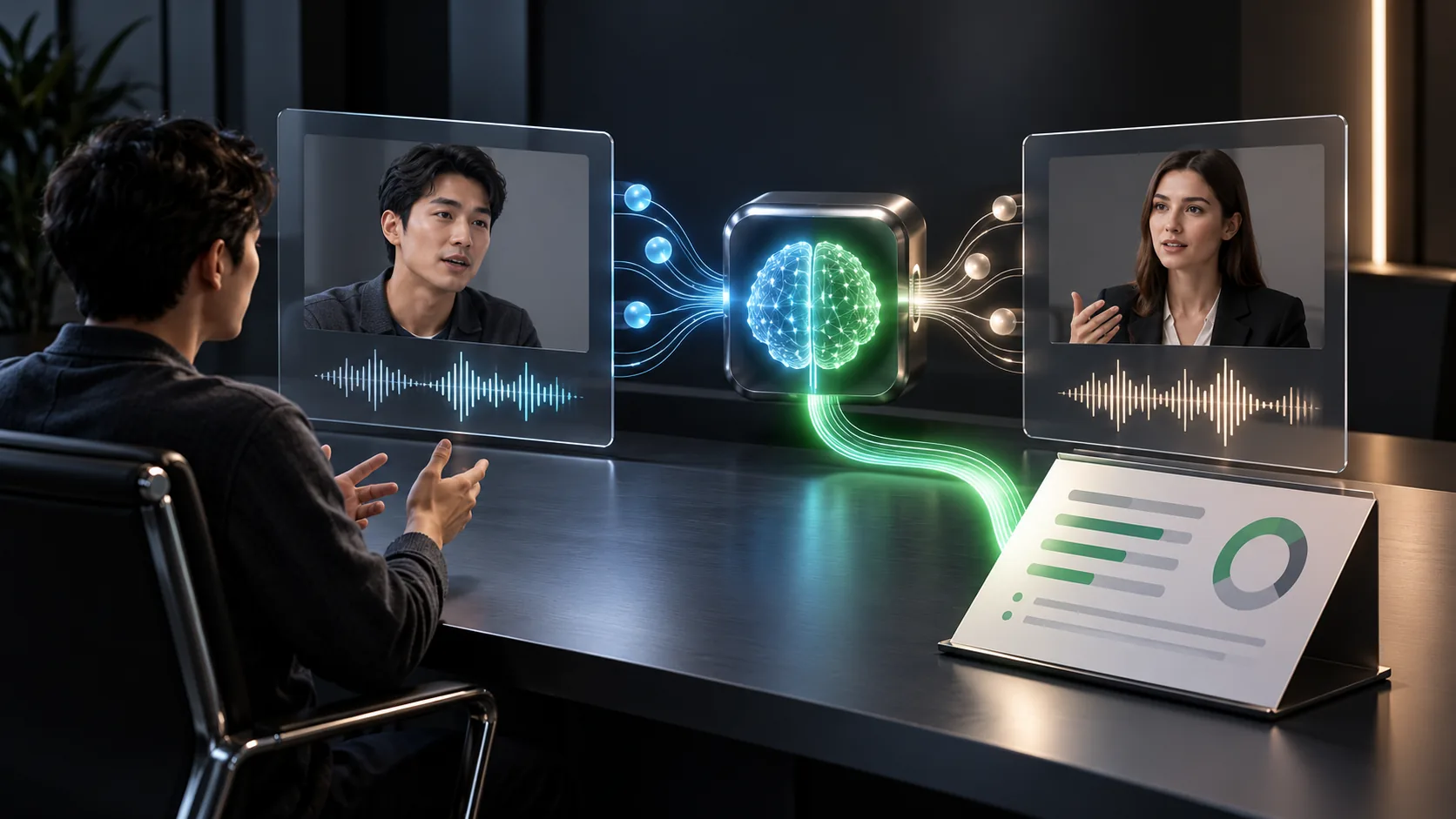
Can technical interview answers be evaluated more consistently?
A local practice system that asks technical questions, compares answers with references, and turns each session into clear feedback.
Explore the systemChoose a role, work through technical questions, and review a record of what you answered. The system makes practice more structured; it does not decide whether someone should be hired.
The application loader verifies a curated base and four approved expansion batches before exposing questions to the interview flow.
Across eight technical domains and three difficulty levels.
Mixed interviews follow Easy → Medium → Hard. That core ladder does not change in response to similarity scores.
CURATION NOTE The active loader combines 487 frozen v5 questions with 179 approved expansion records. The repository states that no question has been reviewed by a human subject-matter expert. The separate legacy /api system retains a 4,085-question bank; it is not the corpus used by the new /demo flow.
The same validated corpus powers question selection, reference-answer comparison, and the session summary.
The new demo plans a structured technical interview, stores each turn locally, and builds the review from the questions and answers in that session.
A role maps to supported technical domains. A job description can add relevance hints.
Curated questions are selected for the role, topic, and planned difficulty.
Write prose or use the code editor for the practical exercise. Save and return later.
Sentence-BERT similarity, exact-word observations, and optional experiments remain distinct.
Answer-aware follow-ups may probe missing concepts; the core difficulty ladder stays fixed.
Difficulty is planned in advance. Similarity and optional evaluators never control the next question’s difficulty.
Default follow-ups use curated concepts and the candidate’s answer. A local-model follow-up mode is optional, explicitly experimental, and not human-validated.
OPTIONAL · EXPERIMENTALLEGACY /api ROUTE The original interview flow is separate and retains adaptive rounds driven by similarity scores. It uses the legacy 4,085-question bank.
The new interview demo uses Sentence-BERT only. Older scorers remain in the repository’s legacy model registry, but they are not selectable for new demo sessions.
all-MiniLM-L6-v2
Embeds the candidate answer and reference answer, then compares their semantic similarity. Reworded answers may resemble the reference, but a high similarity is still not proof of correctness.
Custom PyTorch answer-similarity model trained on the project’s question/answer pairs. The registry notes it mainly saw exact-match positives, so it can be stricter with reworded responses.
Classic text-overlap similarity with a grammar check. The registry’s comparable score is the TF-IDF similarity; grammar is not part of that number.
All model scores measure resemblance to a reference response. None have been validated against expert human marking.
A session summary brings together the transcript and modest evidence signals without turning them into a hiring recommendation.
Similarity is labelled as similarity. Key-concept checks report wording found or not found; absence does not mean an idea was absent, and presence does not prove understanding.
The report records questions, answers, topics, observations, practice areas, and a turn-by-turn transcript. No overall grade is produced.
These are repository screenshots of the real Flask demo, not generated interface mockups.
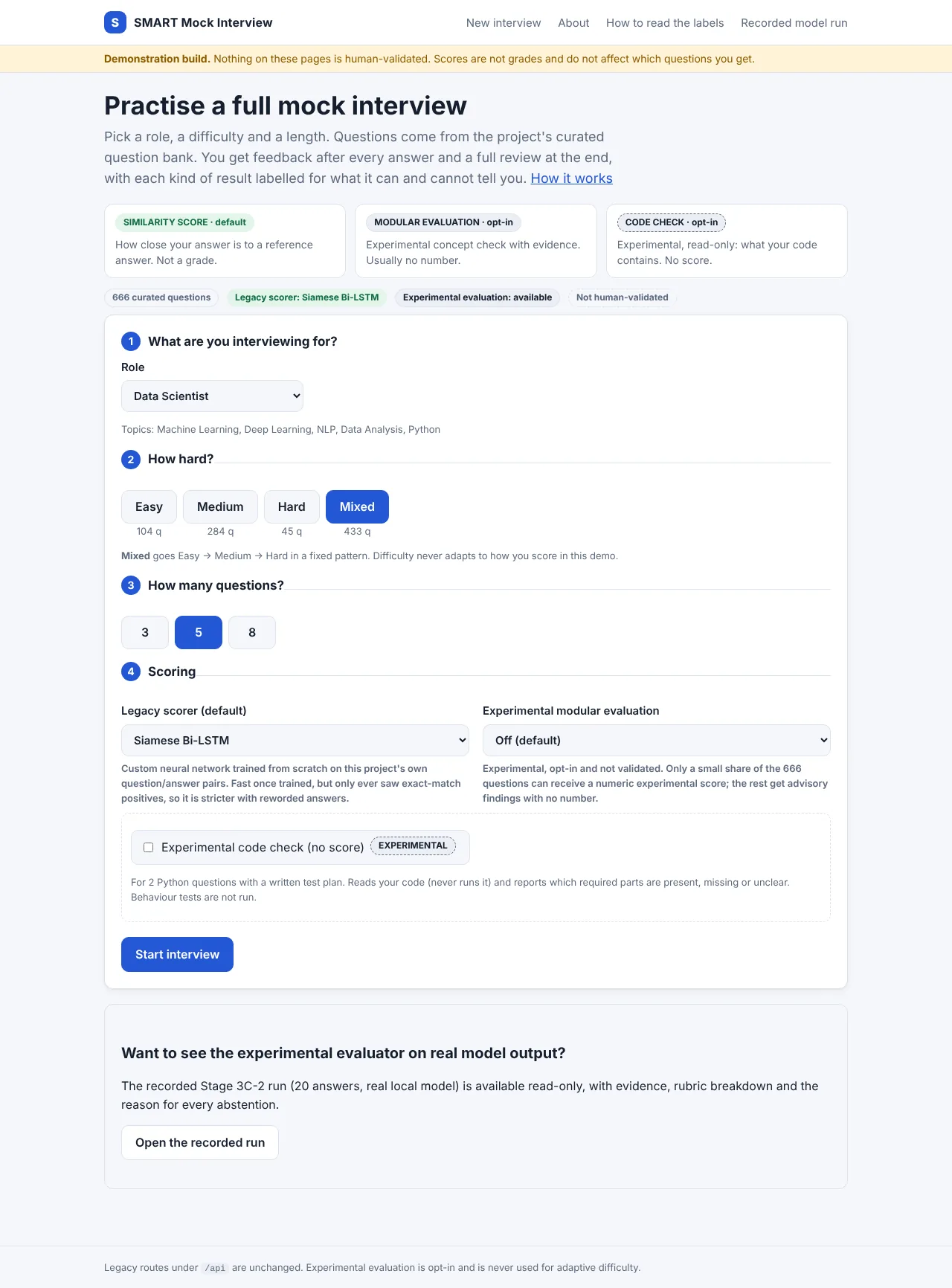
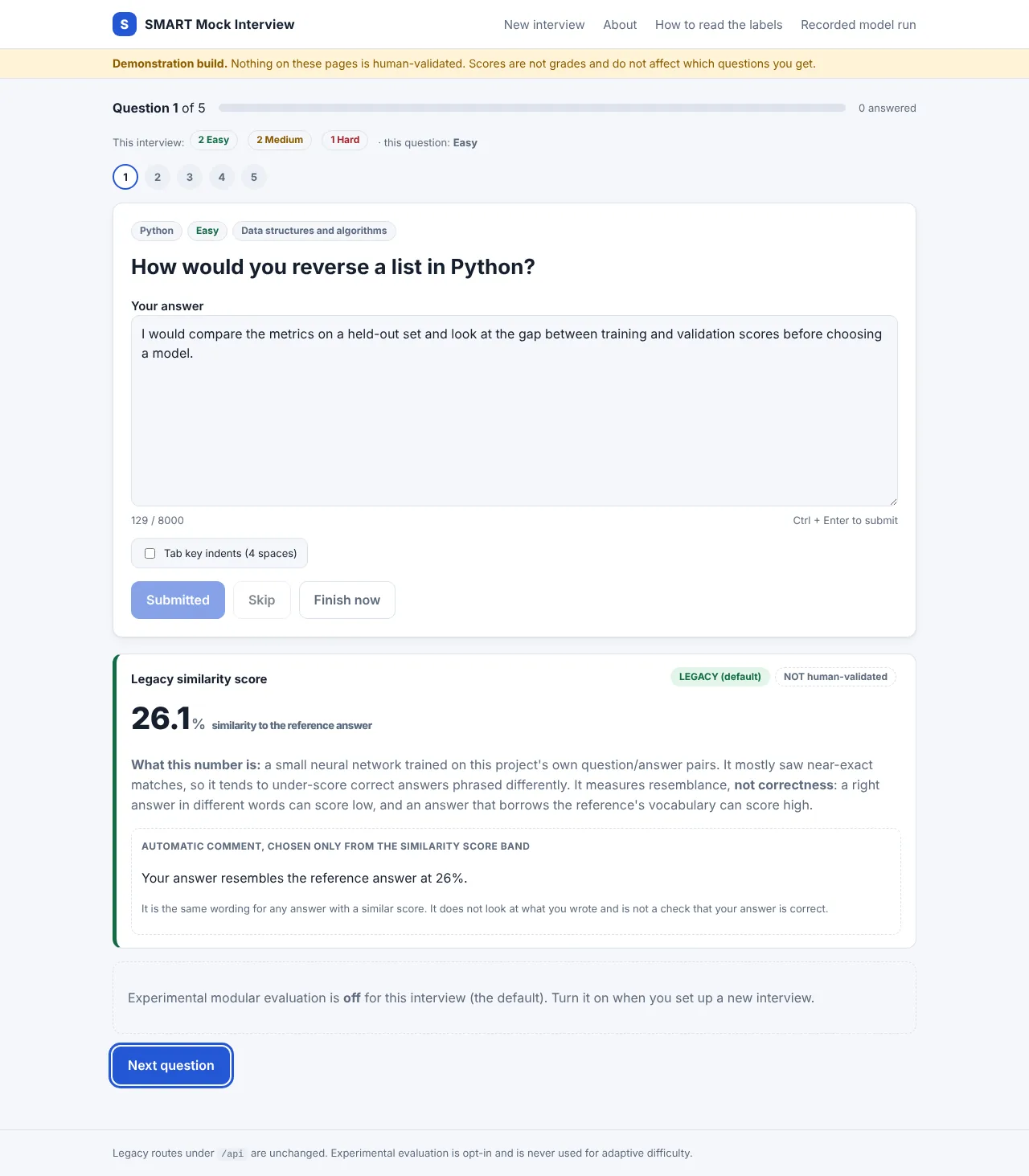


The interview path, opt-in research surfaces, and developer tooling are kept distinct in the implementation and in this case study.
Tooling labels show where each technology belongs.
Human subject-matter review of the question bank, human-rated answer evaluation, and usability research remain needed before any score can be treated as an assessment.
Smart Mock Interview combines a curated technical question bank, semantic answer comparison, answer-aware follow-ups, and session reporting in one local practice system.
The current demo’s similarity score is not validated against human marking. Experimental evaluation and retrieval are separate from the default scoring path.